

- Home
- Symptoms Explainer
- Tinnitus
Tinnitus Explained: Why Ringing in the Ears Is a Nervous System Signal
Persistent ringing, buzzing, or hissing in the ears commonly labeled tinnitus is one of the most misunderstood sensory symptoms in clinical medicine. Although often framed as an ear disorder, tinnitus reflects altered auditory signaling combined with nervous system, emotional, and stress-response dysregulation. Understanding tinnitus as a brain–body network phenomenon explains why the sound persists, why it intensifies under stress, and why regulation not suppressionis the central path forward.
- Published on Dec 23rd, 2025
That persistent ringing, buzzing, or hissing sound in the ears is known as tinnitus. It may appear as a high-pitched whine or a low hum that no one else can hear. These phantom sounds often emerge in quiet environments and can feel sudden and intrusive. Tinnitus is extremely common, with population studies estimating that up to one-third of adults experience it at some point, even if only intermittently (Baguley et al., 2013 PubMed).
The central takeaway is this: tinnitus is not simply an ear problem. The sound itself reflects a broader imbalance across the auditory system, the brain, and the nervous system. While the trigger may originate in the inner ear, the persistent sound is generated and maintained by the brain.
The Initial Spark:
An Inner Ear Trigger
The Inner Ear Trigger
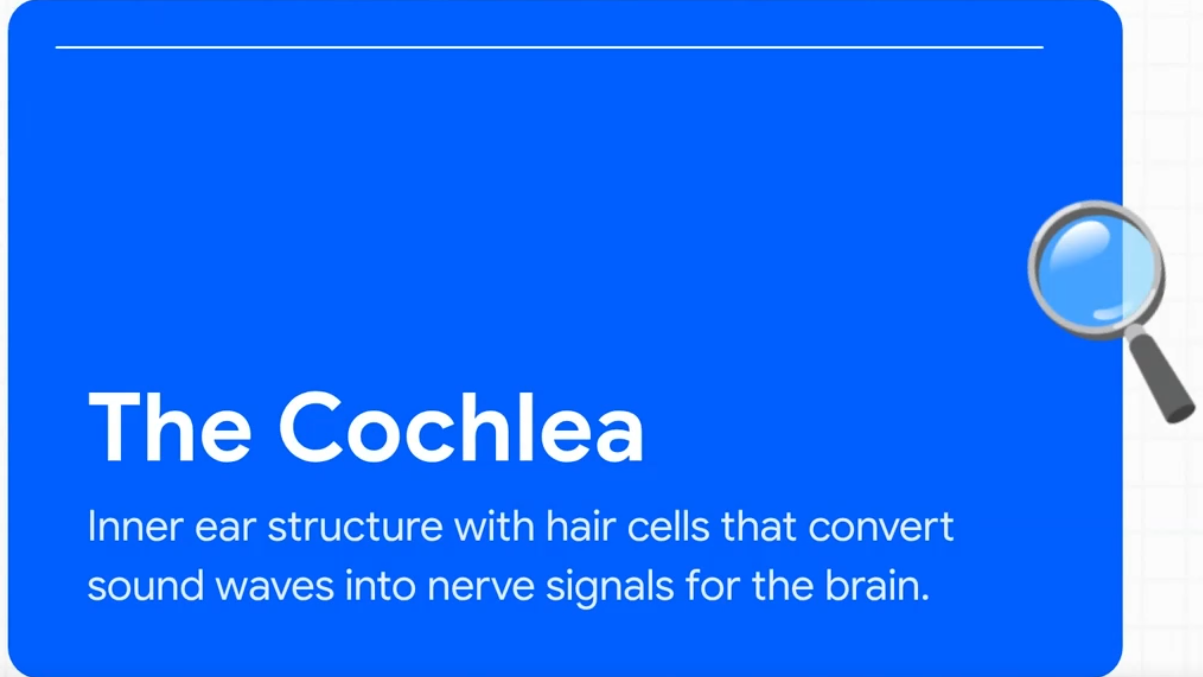
The process often begins with an inner ear disturbance. Deep within the ear lies the cochlea, a spiral-shaped structure lined with thousands of microscopic hair cells. These cells convert mechanical sound waves into electrical signals that the brain can interpret.
When sound input from these hair cells becomes reduced, the system destabilizes.This reduction may result from noise exposure, age-related hearing loss, medication-related ototoxicity, impaired blood flow, or cellular stress.
The Brain's Echo:
A Network Overreaction
These factors reduce the richness of auditory input reaching the brain. Importantly, while the initial disruption may occur in the ear, the phantom sound itself does not originate there.
Maladaptive Plasticity and the Brain’s “Echo”
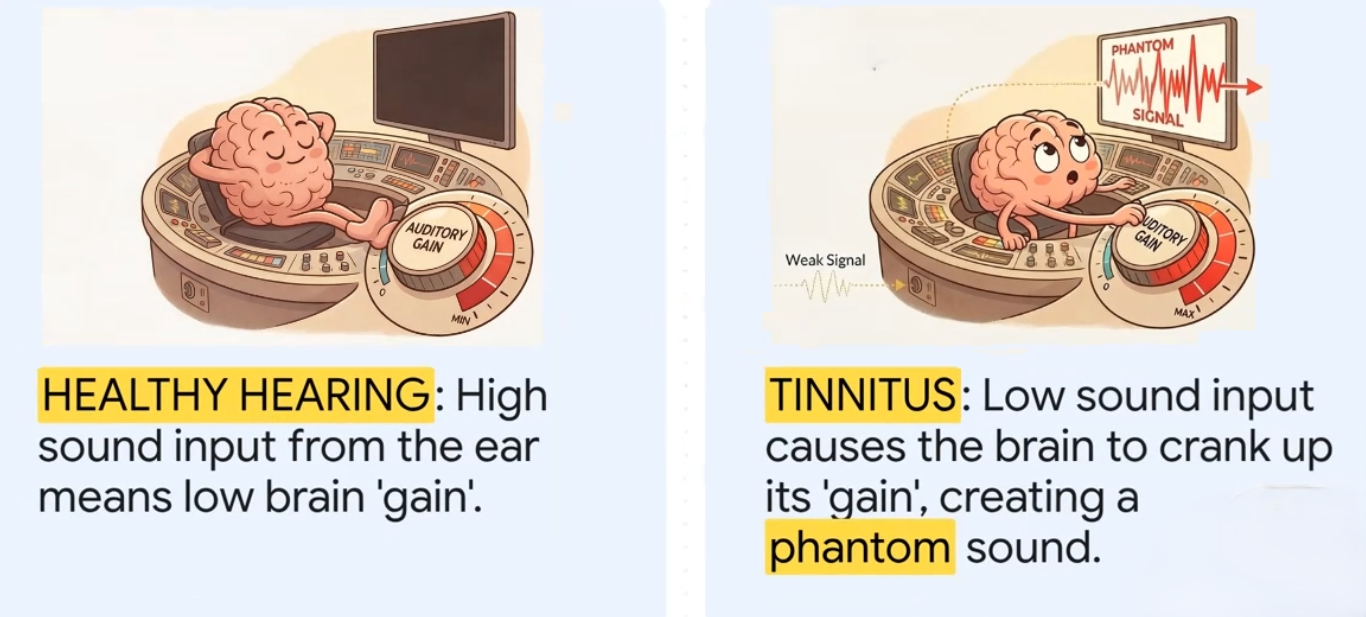
The brain does not tolerate sensory silence. When auditory input diminishes, the brain attempts to compensate through a process known as maladaptive neuroplasticity. Neural circuits increase their internal gain similar to turning up the volume on a stereo when a signal is weak. In doing so, the brain generates its own signal, perceived as tinnitus (Eggermont & Roberts, 2004 PubMed).
In a healthy system, robust auditory input keeps internal gain low. In tinnitus, reduced input prompts the brain to amplify its own activity. The result is a self-generated sound that persists even in silence. This confirms that tinnitus represents a network-level alteration in brain signaling rather than a localized ear defect.
The Body's Amplifiers:
The Feedback Loop
Why the Sound Becomes Loud and Intrusive
For many individuals, tinnitus is not merely present—it becomes intrusive. This occurs because several body systems act as amplifiers for the sound.
Three systems are especially influential:
The autonomic nervous system, which governs stress and arousal
The limbic system, which processes emotion and threat
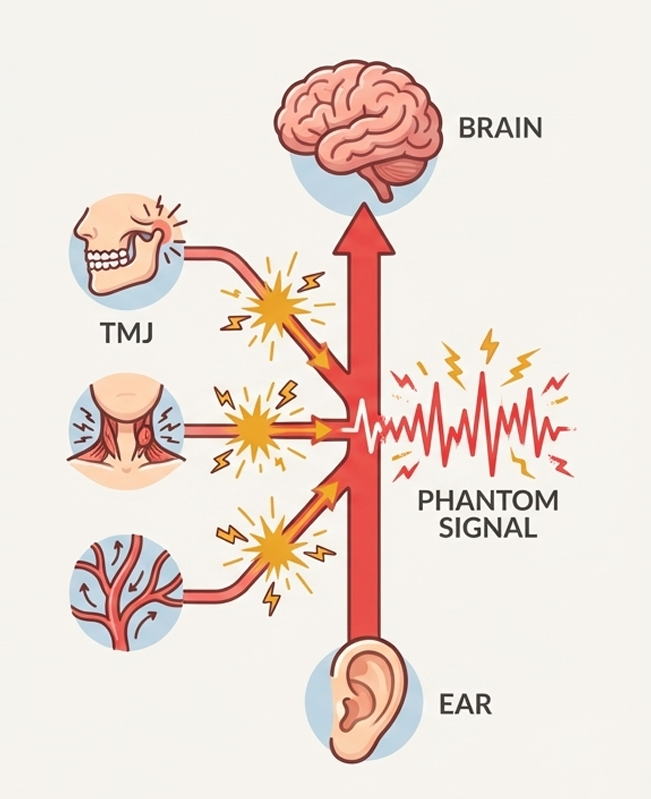
The somatosensory system, particularly tension in the jaw, neck, and upper cervical region
When the autonomic nervous system remains in a chronic stress state, auditory pathways become hypersensitized. Sympathetic activation primes the brain to amplify signals, including internally generated ones. Research shows strong links between stress physiology and tinnitus severity. (Langguth et al., 2011 PubMed).
The Stress–Sound Feedback Loop
Once the phantom sound appears, the limbic system evaluates it. If the sound is interpreted as threatening or alarming, emotional circuits reinforce attention toward it. Heightened attention further amplifies auditory signaling, creating a reinforcing loop.
The sequence unfolds as follows:
The brain detects the sound → the limbic system labels it as a threat → attention intensifies → auditory pathways amplify → the sound grows louder → stress increases. This loop becomes self-perpetuating and explains why tinnitus often worsens during periods of anxiety, fatigue, or overload (Jastreboff & Hazell, 2004 PubMed)
Recalibrating the System:
A New Path Forward
A Whole-System Path Forward
Because tinnitus reflects a network-level disturbance, effective support focuses on recalibrating the entire system rather than attempting to “fix” the ear. Regulation of the brain, nervous system, and stress response becomes the central objective.
- Calming autonomic amplification is foundational. Techniques such as slow breathing and heart rate variability training help shift sympathetic dominance and support parasympathetic tone, reducing auditory gain (Jerath et al., 2006 PubMed).
- Addressing limbic overactivation through cognitive reframing and emotional regulation reduces threat perception and interrupts the stress–sound loop.
- Somatosensory input also matters. Jaw position, cervical posture, and neck tension directly influence auditory nuclei through shared neural pathways. Reducing mechanical tension can meaningfully alter sound intensity (Levine et al., 2003 PMID 14600798).
- Finally, auditory pathways benefit from sound enrichment. Gentle background sounds such as nature noiseprovide the brain with external input, allowing internal gain to decrease naturally rather than remaining maximized in silence.
A Meaningful Signal, Not a Random Malfunction
Tinnitus functions less like a defect and more like a warning light. It signals that neural resilience has been exceeded and that the system is operating in a state of amplification. The sound reflects heightened vigilance, reduced sensory balance, and sustained stress activation.
Rather than representing randomness, tinnitus communicates that the nervous system has lost flexibility. The question then becomes not how to silence the sound, but what the system is signaling through it.
Do You Have Dysautonomia?
Take our quick and comprehensive symptom assessment to find out if your symptoms align with dysautonomia and receive personalized insights.
Is tinnitus always caused by ear damage?
No, While ear-level changes may initiate tinnitus, the persistent sound is generated and maintained by brain and nervous system networks.
Why does tinnitus worsen during stress?
Stress activates the autonomic nervous system, increasing neural gain and amplifying auditory signals.
Can emotional responses make tinnitus louder?
Yes, Limbic system activation reinforces attention and threat perception, intensifying the sound.
Does posture or jaw tension affect tinnitus?
Yes, Somatosensory input from the neck and jaw directly interacts with auditory processing centers.
Why does silence make tinnitus more noticeable?
Without external sound input, the brain increases internal gain, making phantom sounds more prominent.
Can breathing exercises reduce tinnitus intensity?
Slow breathing supports parasympathetic regulation and reduces stress-driven amplification.
Is tinnitus permanent?
Tinnitus reflects neural plasticity. With appropriate regulation, the system can recalibrate and reduce symptom intensity.
References
Baguley D et al., 2013 — Tinnitus
Lancet.
PubMed: https://pubmed.ncbi.nlm.nih.gov/23827090/
Eggermont JJ & Roberts LE, 2004 — The neuroscience of tinnitus
Trends Neurosci.
PubMed: https://pubmed.ncbi.nlm.nih.gov/15474168/
Langguth B et al., 2011 — Tinnitus and stress
Prog Brain Res.
PubMed: https://pubmed.ncbi.nlm.nih.gov/21889279/
Jastreboff PJ & Hazell JW, 2004 — Neurophysiological model of tinnitus
J Am Acad Audiol.
PubMed: https://pubmed.ncbi.nlm.nih.gov/8723954/
Levine RA et al., 2003 — Somatic modulation of tinnitus
Neurology.
PubMed: https://pubmed.ncbi.nlm.nih.gov/14600798/
Jerath R et al., 2006 — Breathing and autonomic regulation
Med Hypotheses.
PubMed: https://pubmed.ncbi.nlm.nih.gov/16624497/
Read More Articles

Joint Pain Explained: When Inflammation Becomes a Systemic Signal
Home Symptoms Explainer Joint Pain The Systemic Roots of Joint Pain Joint pain is not merely a mechanical issue of cartilage wearing down, it is often a systemic signal of deeper biological stress. Emerging research on systemic inflammation and joint pain reveals the interconnected roles of the gut, mitochondria, and
Vertigo: Why the Nervous System Causes Chronic Dizziness (POTS, Dysautonomia, Chronic Illness)
Vertigo is not simply a balance problem, it’s a sign of deeper physiological dysregulation involving the vestibular system, blood flow, gut-brain axis, and stress response. This article explores how inflammation, posture, and autonomic imbalance contribute to dizziness and offers insight into restoring internal balance.
Why You Can’t “Just Calm Down”: Chronic Anxiety (It’s Not Just In Your Head!)
Chronic anxiety is more than an emotion, it’s a full-body state of dysregulation involving the nervous system, mitochondria, and stress hormones. Learn how overactive brain circuits, gut imbalance, and energy metabolism interact to sustain anxiety, and how retraining the body restores calm regulation.
Explaining Palpitations
Heart palpitations can feel sudden and alarming, yet they usually arise from the body’s regulation systems, not from heart disease. This article explores how stress, posture, breathing, hydration, minerals, and gut health affect rhythm and reveal the body working to stay balanced.
Temperature Sensitivity
Many people struggle with feeling too hot or too cold when others feel fine. This article explores how the autonomic nervous system, cellular energy, and inflammation control internal temperature and why these systems can fall out of balance.
Why Your Hands Get Freezing Cold
Cold hands and feet often reflect more than poor circulation, they’re signals from the nervous system. This article explains how vasoconstriction, stress, and autonomic imbalance redirect blood flow and what that reveals about the body’s intelligent protective mechanisms.