- Home
- Symptoms Explainer
- Sweating
Why Sweating Too Much or Too May Signal Autonomic Nervous System Dysregulation
Sweating that is unusually high (excessive) or unusually low (absent or reduced) can be a visible sign that the autonomic nervous system (the body’s automatic control system) is out of balance. This article explains how sweating is controlled, why abnormalities happen, and what these patterns may indicate about your internal regulatory systems.
- Published on Nov 25th, 2025
Sweating is one of the body’s oldest ways to regulate temperature. Under normal conditions, we sweat to cool down. But when sweating becomes unusually intense or nearly absent, it often reflects deeper signaling issues within the autonomic nervous system (ANS). This system controls automatic functions like heart rate, blood pressure, digestion, temperature regulation, and sweat production.
Sweating changes can be confusing and distressing. Many individuals experience episodes of sweating for no identifiable reason, while others feel overheated and unable to sweat. These opposite sensations share a common message: the body is attempting to signal something important.
How Normal Sweating Works
The autonomic nervous system tells sweat glands when to turn on or off. Normally:
The sympathetic branch activates sweat glands in response to heat or exertion
The hypothalamus (brain thermostat) processes temperature input
Sweat cools the body as it evaporates
When any part of that system misreads temperature or misfires signals, sweat output can become too high or too low, even when it shouldn’t be.
Signs of Abnormal Sweating Patterns
Common symptoms people with sweating dysregulation may notice:
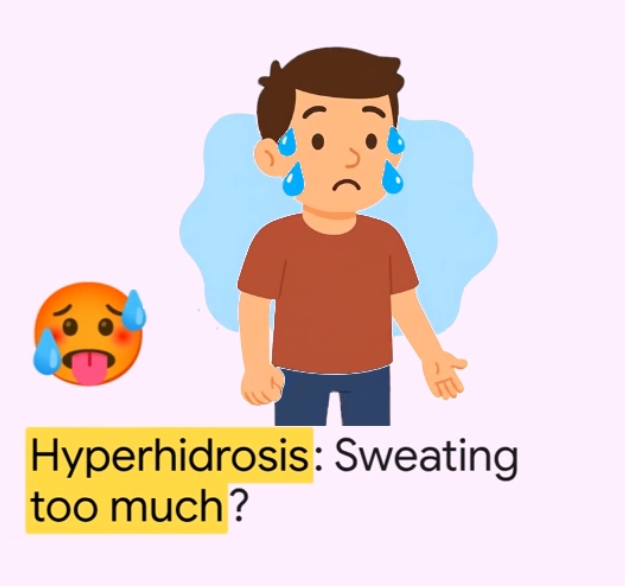
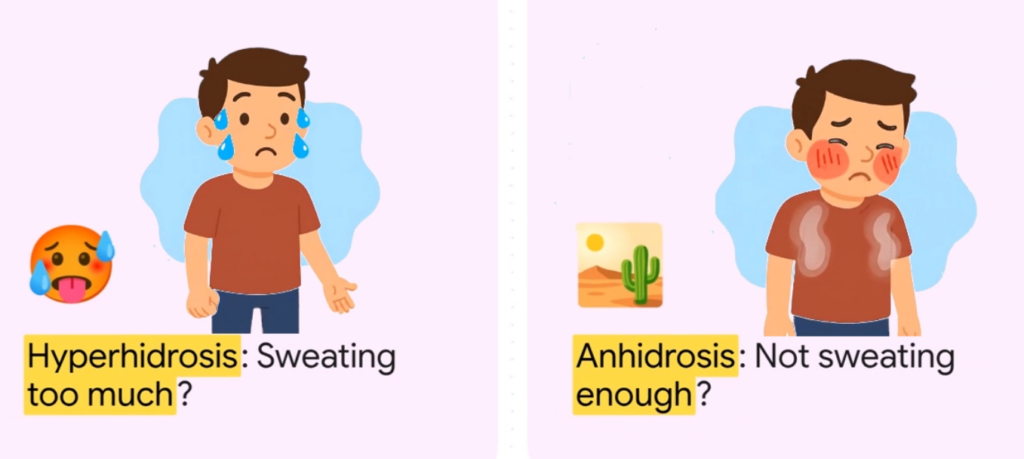
✔ Sweating excessively even at rest or in cool environments
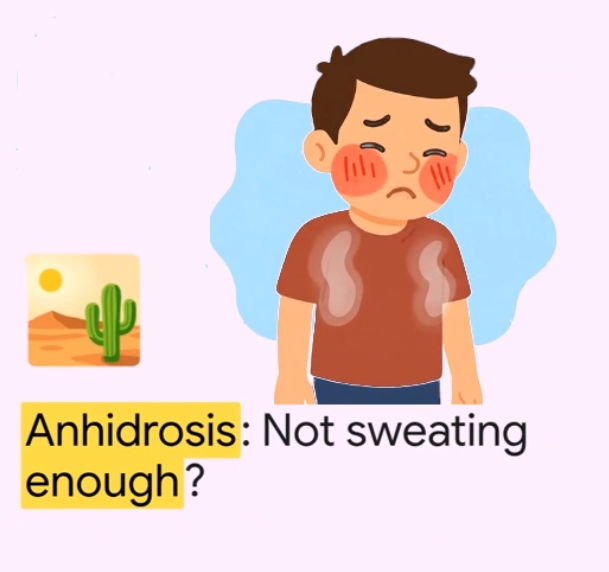
✔ Reduced or absent sweating (anhidrosis)
✔ Uneven sweating across different body areas
✔ Sweating triggered by emotion rather than heat
Many of these patterns are associated with autonomic nervous system dysfunction, and may very likely all under the umbrella of dysautonomia.
The autonomic nervous system functions
The autonomic nervous system functions as the body’s automatic pilot, controlling processes such as heart rate, blood pressure, digestion, temperature regulation, and sweating. It maintains equilibrium without conscious effort. When this system becomes dysregulated, sweating patterns shift, sometimes dramatically.
Why The System Misfires:
Wiring & Signaling
What Causes Sweating Dysregulation?
Let’s explore 5 common causes of sweating dysregulation.
1. Damaged Nerve Fibers: Small Fiber Neuropathy
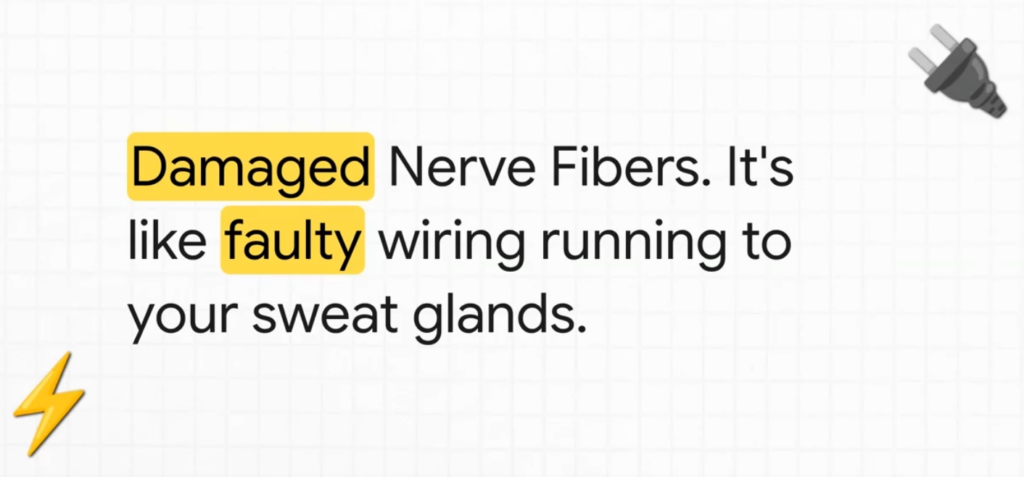
The first cause involves the physical communication lines of the body. Very small nerve fibers connect directly to sweat glands.
When these fibers become damaged often through inflammation, infection, metabolic conditions, or autoimmune processes the sweat signal becomes unreliable. This is characteristic of small fiber neuropathy, where nerve endings become impaired, leading to patchy sweating or regions that do not sweat at all (Oaklander et al., 2013 PubMed).
Essentially, the damage to the small nerve fibers that connect sweat glands directly to the nervous system can cause patchy sweating or an inability to sweat. This is common in peripheral autonomic neuropathies.
2. Faulty Temperature Signaling to the Brain
Another contributor is inaccurate sensory feedback regarding temperature. When blood flow becomes unstable especially blood flow to the skin the brain may misinterpret thermal signals, similar to a malfunctioning thermostat. Individuals with postural orthostatic tachycardia syndrome (POTS) often experience these distortions, where sweating worsens symptoms by increasing fluid loss in an already volume-limited state (Raj, 2013 PubMed).
When this happens, it is the inaccurate temperature input that causes the brain to trigger sweating responses that do not match actual body temperature, leading to sudden or inappropriate sweating episodes.
Why The System Misfires: Part 2
System Overload
Sympathetic Overdrive and Sympathetic Exhaustion
Beyond faulty wiring, the autonomic system itself may become overloaded. Sympathetic overactivation, which is commonly called “fight-or-flight” can remain chronically elevated. Chronic sympathetic activation is linked to increased sweating, cardiovascular strain, and autonomic instability (Goldstein, 2010 PubMed).
When this system (the ANS) remains on high alert, sweating may occur during rest or mild emotional stress. Over time, prolonged activation may blunt sympathetic output, contributing to reduced sweating or episodes of anhidrosis. The same system produces both extremes, simply at different stages of exhaustion.
Hormonal and Inflammatory Triggers
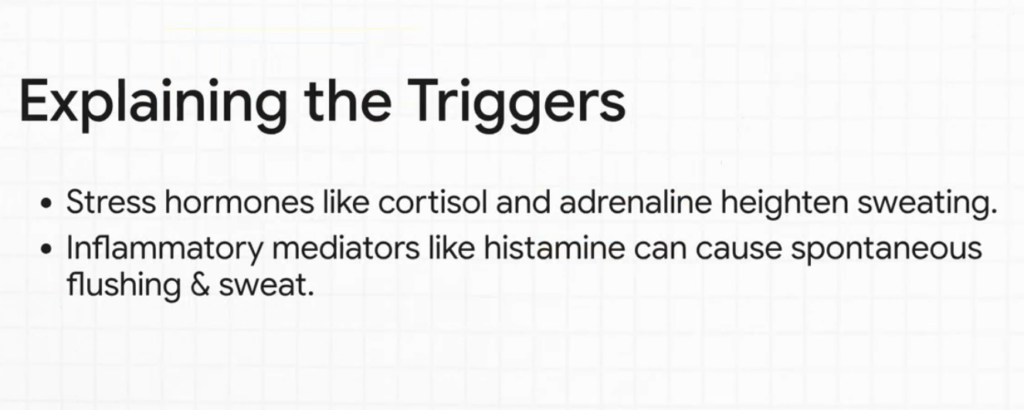
Our internal chemistry exerts a strong influence on sweating. Hormones such as adrenaline and cortisol are designed to mobilize energy and prepare the body for action. Their elevation increases sweating.
With chronic stress, these hormones remain elevated, keeping the sweating signal active. Let’s take a look at how inflammation affects this.
Inflammatory mediators including histamine can trigger flushing and episodic sweating unrelated to environmental temperature. Histamine’s role in vasodilation and sweat activation has been demonstrated in autonomic and skin-level studies. Now that we know about the hormonal and inflammatory triggers, let’s look at the emotional side of things.
Emotional Overactivation of the Limbic System
Another major contributor is emotional overactivation. The limbic system, the brain’s emotional center, plays a central role in autonomic regulation.
Factors such as trauma, chronic illness, or prolonged threat-monitoring may sensitize limbic circuits, creating heightened sympathetic readiness. When the brain becomes stuck in this state, this limbic hyperactivation can generate sweating episodes driven by perceived stress rather than actual temperature demands.
Sweating becomes tied not to heat, but to the brain’s interpretation of safety.
Now, let’s take a look at what happens on a cellular level.
Reduced Cellular Energy and Mitochondrial Function
Insufficient sweating (not sweating enough) called anhidrosis may reflect an energy shortage at the cellular level. Sweat production is metabolically demanding. The mitochondria, responsible for cellular ATP generation, must supply adequate energy for sweat gland function. Mitochondrial dysfunction reduces available energy, prompting the body to conserve resources and downregulate nonessential processes, including sweating.
Studies have now shown that this altered mitochondrial function has been linked to impaired thermoregulation and autonomic symptoms (Picard et al., 2016 PubMed).
Bringing It Together: The Broken Thermostat
Now we understand the hormonal, inflammation, emotional and mitochondrial factors and their role, let’s tie this all together.
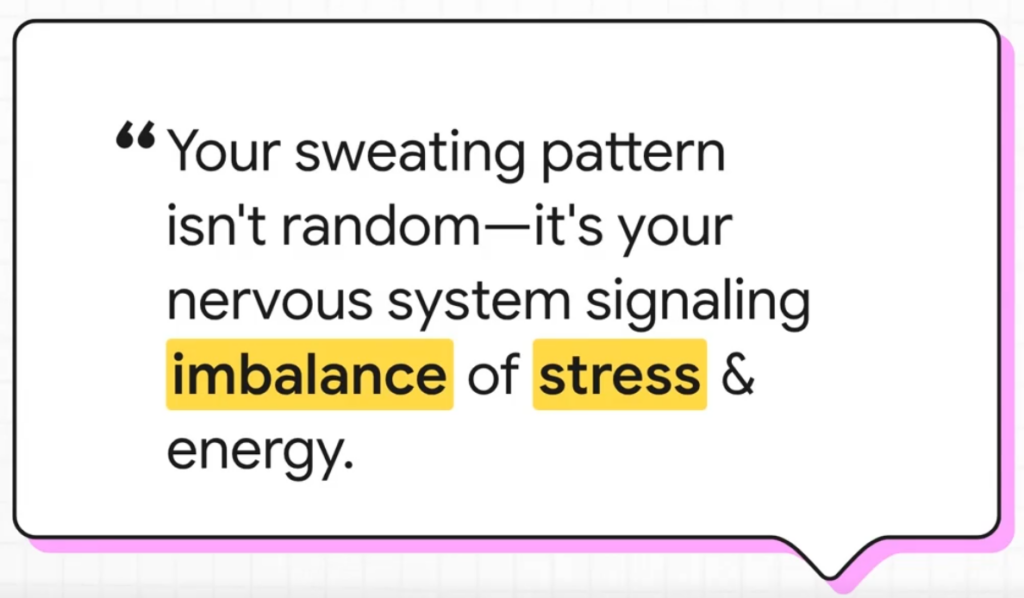
Sweating patterns are not random. They reflect the autonomic nervous system’s difficulty reading and responding to internal states. The system acts like a thermostat stuck in dysregulation sometimes blasting air conditioning, sometimes withholding it because it cannot obtain an accurate temperature reading.
The body sends signals. Sweating too much or too little is one of them.
A Three-Part Path Toward Regulation of Sweating
Three foundational strategies help rebalance the nervous system, which in turn ca restore balance to the factors causing the abnormal sweating:
Restore (Hydration & Electrolytes): Provide raw materials such as hydration and electrolytes to stabilize circulatory and autonomic function.
- Retrain (Nervous System Exercises): Use breathing practices and nervous system training to shift sympathetic overactivation and support parasympathetic tone (Jerath et al., 2006 PubMed).
- Reacclimate (Gradual Temperature Exposure): Gently expose the body to varied temperatures, allowing the thermostat to relearn appropriate responses.
Sweating becomes a meaningful message; it’s a signal of how stress, circulation, and energy regulation are interacting in the moment. The autonomic nervous system communicates continuously. The task is to understand what the signal is communicating. So, what is your body’s thermostat telling you?
Conclusion
Abnormal sweating (too much or too little) is not random. It often reflects autonomic nervous system imbalance, signaling disruptions in how the body regulates temperature, stress responses, circulation, and energy. Understanding this symptom opens a window into deeper functional health insights.
If you have experienced abnormal sweating or other unexplained symptoms, take our free Symptoms Evaluation Assessment to learn more and get key insights into what could be coming up for you.
Do You Have Dysautonomia?
Take our quick and comprehensive symptom assessment to find out if your symptoms align with dysautonomia and receive personalized insights.
What causes sweating to become dysregulated in dysautonomia?
Sweating changes often arise from impaired nerve fibers, altered blood flow, sympathetic overactivation, inflammatory signaling, or reduced mitochondrial energy. These factors disrupt autonomic control of sweat glands.
Can small fiber neuropathy lead to both increased and decreased sweating?
Yes. Damage to small nerve fibers can reduce sweating in affected areas, while unaffected regions may compensate with excessive sweating.
How does POTS contribute to abnormal sweating?
POTS alters circulation and temperature signaling. The brain may misinterpret heat cues, triggering sweating at inappropriate times. Sweating can worsen symptoms due to fluid loss.
Why does chronic stress increase sweating?
Chronic activation of adrenaline and cortisol heightens sympathetic activity, which directly increases sweating frequency and intensity.
Can emotional stress cause sweating even without physical exertion?
Yes. Limbic system activation can stimulate sympathetic pathways, producing sweating based on perceived threat rather than temperature.
Does reduced mitochondrial energy truly affect sweat production?
Yes. Sweat glands require substantial ATP. When mitochondrial output decreases, the body prioritizes essential functions and may reduce sweating.
Is sweating too little dangerous?
Anhidrosis can impair heat dissipation and contribute to overheating. It also signals autonomic or metabolic imbalance requiring clinical evaluation.
References
- Oaklander AL et al., 2013 — Small Fiber Neuropathy
PubMed: https://pubmed.ncbi.nlm.nih.gov/23815232 - Raj SR, 2013 — Postural Tachycardia Syndrome
PubMed: https://pubmed.ncbi.nlm.nih.gov/23753844 - Goldstein DS, 2010 — Stress System & Sympathetic Activation
PubMed: https://pubmed.ncbi.nlm.nih.gov/21061156 - Jerath R et al., 2006 — Breathing & Autonomic Regulation
PubMed: https://pubmed.ncbi.nlm.nih.gov/16624497 - Picard M et al., 2018 — Mitochondria & Stress Physiology
PubMed: https://pubmed.ncbi.nlm.nih.gov/27026247
Read More Articles

Joint Pain Explained: When Inflammation Becomes a Systemic Signal
Home Symptoms Explainer Joint Pain The Systemic Roots of Joint Pain Joint pain is not merely a mechanical issue of cartilage wearing down, it is often a systemic signal of deeper biological stress. Emerging research on systemic inflammation and joint pain reveals the interconnected roles of the gut, mitochondria, and
Vertigo: Why the Nervous System Causes Chronic Dizziness (POTS, Dysautonomia, Chronic Illness)
Vertigo is not simply a balance problem, it’s a sign of deeper physiological dysregulation involving the vestibular system, blood flow, gut-brain axis, and stress response. This article explores how inflammation, posture, and autonomic imbalance contribute to dizziness and offers insight into restoring internal balance.

Why You Can’t “Just Calm Down”: Chronic Anxiety (It’s Not Just In Your Head!)
Chronic anxiety is more than an emotion, it’s a full-body state of dysregulation involving the nervous system, mitochondria, and stress hormones. Learn how overactive brain circuits, gut imbalance, and energy metabolism interact to sustain anxiety, and how retraining the body restores calm regulation.

Explaining Palpitations
Heart palpitations can feel sudden and alarming, yet they usually arise from the body’s regulation systems, not from heart disease. This article explores how stress, posture, breathing, hydration, minerals, and gut health affect rhythm and reveal the body working to stay balanced.
Temperature Sensitivity
Many people struggle with feeling too hot or too cold when others feel fine. This article explores how the autonomic nervous system, cellular energy, and inflammation control internal temperature and why these systems can fall out of balance.
Why Your Hands Get Freezing Cold
Cold hands and feet often reflect more than poor circulation, they’re signals from the nervous system. This article explains how vasoconstriction, stress, and autonomic imbalance redirect blood flow and what that reveals about the body’s intelligent protective mechanisms.