
Nerve Pain Explained: Why Burning, Tingling & Electric Sensations Happen When Tests Are Clear

Nerve pain often appears as burning, tingling, or sudden electric sensations, and it can be deeply confusing when medical tests show no structural damage.

Yet research shows that these symptoms frequently arise from functional nerve damage, not structural damage. When oxygen delivery, mitochondrial energy, the immune system, or the brain’s threat response becomes dysregulated, nerve signals amplify. Understanding this helps reframe nerve pain not as “damage,” but as a message from a system under pressure.

Written by Scott Pringle, Founder of the Integrated Health Foundation
Table of Contents

Nerve pain is one of the most confusing and frustrating things the body can experience. It feels different from muscle pain and is often described by burning or heat sensations, pins and needles, electric zaps or random jolts that appear without warning. 

These sensations have real biological explanations, and they often reflect systems-level imbalance, not nerve destruction. 

Let’s explore the burning, tingling, and shooting sensations to understand what those alarms are actually trying to communicate.

This is the big question: the pain feels real and disruptive, but every scan and test comes back clear. It’s enough to make someone feel confused. But what if the pain isn’t a sign that something is broken, but a message from a system that is overwhelmed?

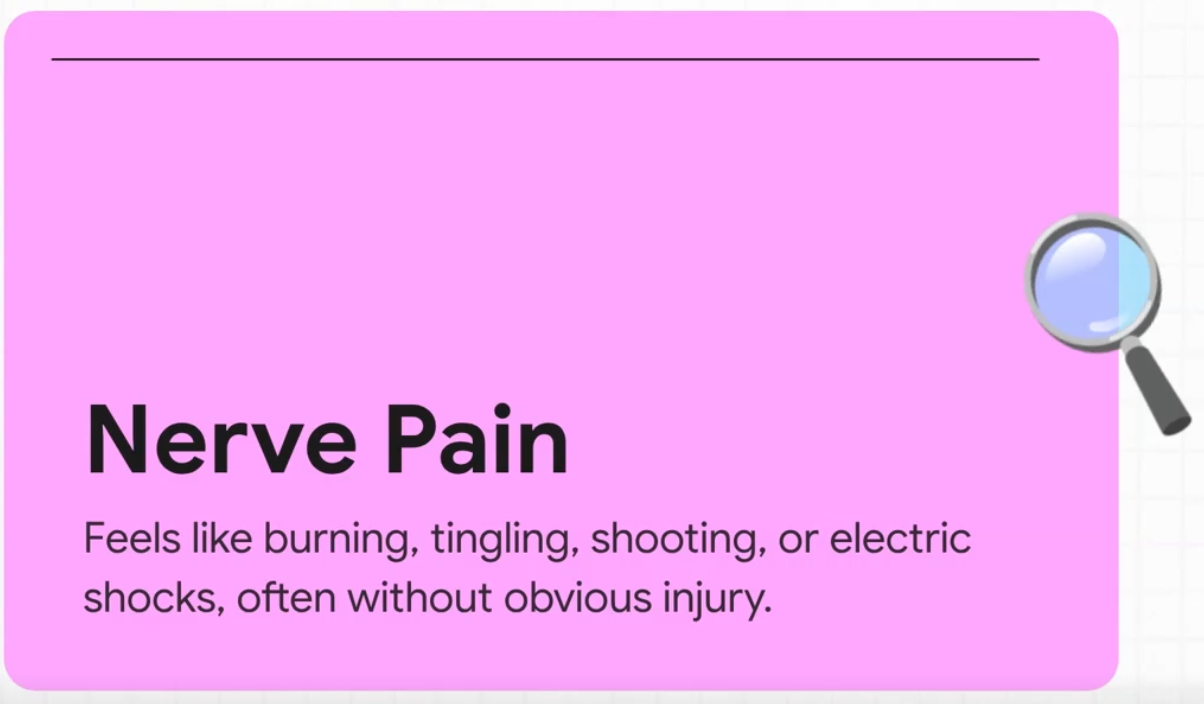
Title slide defining nerve pain as burning, tingling, shooting, or electric sensations without obvious injury.

What Nerve Pain Feels Like

First, it helps to get on the same page. What is nerve pain? We know it isn’t a typical muscle ache. It is a very specific set of sensations often described as burning, pins and needles, and sudden electric-zaps that appear without warning. If that feels familiar, keep reading because there is a real biological explanation.

Title slide defining nerve pain as burning, tingling, shooting, or electric sensations without obvious injury.

Often when people think about nerve pain, they think it’s one small nerve somewhere creating a misfire, but that is not the case. This is a system-wide issue. The brain, immune system, and stress response are all involved. Their quiet conversation has turned into a shouting match. Let’s explore what causes this nerve pain and how you can overcome it. 

Text stating nerve pain involves the entire system: brain, immune system, and stress response.
1

System Power Failures:
Oxygen & Energy Deficits

System Power Failures: Oxygen & Mitochondrial Energy Deficits

The first clue is system power failures. Nerves need two basic resources to function: oxygen and energy. When those resources drop, the system becomes unstable.

On one side, there is a nervous system that gets everything it needs. On the other, poor circulation starves nerves of oxygen, and energy shortages make them fire signals randomly. It’s like running a supercomputer on dying batteries.

Side-by-side comparison showing good blood flow and energy supply versus poor circulation and energy deficits.

How low oxygen contributes to nerve pain

Nerve hypoxia happens when the autonomic nervous system cannot deliver enough oxygen-rich blood. That irritates nerves.

How low mitochondrial output contributes

Nerves are energy-intensive. When mitochondria cannot meet demand, their firing becomes erratic which creates burning, buzzing, or tingling sensations. (Ribeiro PSS et al., 2022 PMC). Additional reviews suggest mitochondrial dysfunction is a driver of neuropathic pain (Espinoza N et al., 2025 MDPI)

This is often why symptoms worsen with stress, heat, exertion, or poor sleep. Because the energy reserves drop, and the system destabilizes.

Graphic listing poor circulation and energy deficits as two main failures that affect nerve function.
2

The Inflammation Alarm:
The Body's Defense System

The Inflammation Alarm: Immune Activation & Mast Cells

Our supercomputer running on low batteries is only a small part of the picture.  Nerve pain can also arise when the immune system becomes hypersensitive. This leads to the second major clue called the inflammation alarm.

Sometimes the body’s defence system becomes confused. It becomes activated and doesn’t only respond to threats, it also irritates nerves.

This often follows a predictable chain:

  1. An imbalanced gut triggers body-wide inflammation.
  2. That inflammation activates immune cells, including mast-cells.
  3. Mast-cells release chemicals that directly sensitize nerves (Mai L et al., 2021 Frontiers)
  4. The result is hyper-excitable pain receptors. They are on a hair trigger, turning the volume way up on even small sensations.

This creates hypersensitivity, a system on “high alert,” where even small inputs feel amplified.

Think of it like a smoke alarm going off for toast. The mast-cell-nerve interaction has been well documented as contributing to neurogenic inflammation (Gupta K et al., 2018 PMC)

Three-step diagram showing gut imbalance leading to immune activation and nerve hypersensitivity.
Text explaining that the immune system can make nerves oversensitive and increase pain volume.
3

The Threat Detector:
The Brain's Role

The Brain’s Threat Detector (Limbic Stress Response)

The brain plays a major role in how nerve signals are processed. This leads to the third clue: the brain as the master threat detector. This is where perception and physical processes meet. The threat-detection system can become stuck in the “on” position.

Quote card stating that nerve pain is not in the mind but rooted in neurochemistry.

This is not imaginary. It is a measurable change in the brain’s chemistry. For example, research shows that when individuals perceive a constant threat, such as pain or potential harm, amygdala and other brain-regions remain hyper-activated (Ahmad AHM et al., 2014 PMC) and threat-bias in pain perception further modulates neural networks (Lim M et al., 2020 Journal of Neuroscience)

Two Primary Contributors to Amplified Nerve Pain

  • The limbic system, the emotional brain. Chronic stress or fear keeps the body locked in fight-or-flight, naturally increasing the volume of pain signals.
  • Inputs from the upper neck. Even mild tension or misalignment can send faulty sensory signals, creating burning or tingling sensations somewhere else.
Graphic describing two triggers for nerve pain: limbic system stress responses and cervical spine sensory input.
4

The Answer:
A System Overwhelmed

The Big Picture: A System Overwhelmed

At this point, all the clues come together: power failures, inflammation alarms, and an over-active threat detector. Together they point to a body stuck in high alert.

  • Power failures cause irritation, which feels like burning and tingling.
  • Inflammation alarms cause hypersensitivity, which feels like shooting pains and aches.
  • The threat detector amplifies everything, creating sensitivity throughout the body.

These layers build until the system becomes overwhelmed.

Table showing three clues behind nerve pain: power failures causing irritation, inflammation causing hypersensitivity, and threat detection causing amplification.
Quote card stating that when the body feels safe again, pain pathways quiet down and nerves can rest.

The Shift in Perspective

This changes the approach. The aim is not to attack the pain. The pain is the messenger. The real work involves calming the entire system, restoring balance, and identifying why the alarms activated.

The Answer: Restore System Safety

Everything comes down to safety. When the brain and body stop sensing ongoing threat, whether from inflammation, stress, or an energy deficit, pain pathways naturally quiet. Nerves finally receive the rest they need.

The final idea? Instead of fighting the pain, focus on creating a deep sense of internal safety within the body. That shift may be the key to meaningful change.

If this resonates and you’d like to understand what your symptoms may be signaling, you’re welcome to explore our program or take our free Symptoms Evaluation Assessment to begin uncovering the root cause.

Text graphic asking whether healing begins by restoring safety instead of fighting pain.

Do You Have Dysautonomia?

Take our quick and comprehensive symptom assessment to find out if your symptoms align with dysautonomia and receive personalized insights.

Frequently Asked Questions
Why can nerve pain feel severe even when scans are normal?

Nerve pain frequently originates from functional disturbances, reduced oxygenation, metabolic strain, or heightened neural sensitivity, rather than visible structural injury. These changes often pose no findings on MRI or CT imaging but still alter nerve firing behavior (Finnerup et al., 2021 PubMed).

Inadequate microcirculation lowers oxygen delivery to nerves, known as nerve hypoxia. Even mild reductions in perfusion can destabilize nerve signaling, increasing burning or tingling sensations.

Nerves rely heavily on mitochondrial ATP production. When mitochondrial output declines due to stress, illness, or metabolic dysfunction sensory neurons may become hyper-reactive, contributing to neuropathic sensations (Ribeiro et al., 2022 PMC).

Yes. Immune activation, particularly involving mast cells, releases mediators like histamine, tryptase, and cytokines that directly sensitize peripheral nerves and increase pain signal amplification (Mai et al., 2021 Frontiers).

The limbic system, responsible for emotional and threat processing, modulates pain pathways. Persistent stress maintains a high-alert state that amplifies nociceptive signaling in the brain, increasing the intensity of nerve sensations.

Sensory nerves entering the brainstem from the upper cervical spine can influence pain-processing networks. Even minor tension or misalignment in this region can produce misleading sensory input that the brain interprets as tingling or burning elsewhere in the body (Bogduk, 2009 PubMed).

References


Read More Articles

joint pain explained

Joint Pain Explained: When Inflammation Becomes a Systemic Signal

Home Symptoms Explainer Joint Pain The Systemic Roots of Joint Pain Joint pain is not merely a mechanical issue of cartilage wearing down, it is often a systemic signal of deeper biological stress. Emerging research on systemic inflammation and joint pain reveals the interconnected roles of the gut, mitochondria, and
Read More »

Explaining Palpitations

Heart palpitations can feel sudden and alarming, yet they usually arise from the body’s regulation systems, not from heart disease. This article explores how stress, posture, breathing, hydration, minerals, and gut health affect rhythm and reveal the body working to stay balanced.
Read More »
Temperature Sensitivity

Temperature Sensitivity

Many people struggle with feeling too hot or too cold when others feel fine. This article explores how the autonomic nervous system, cellular energy, and inflammation control internal temperature and why these systems can fall out of balance.

Read More »

Why Your Hands Get Freezing Cold

Cold hands and feet often reflect more than poor circulation, they’re signals from the nervous system. This article explains how vasoconstriction, stress, and autonomic imbalance redirect blood flow and what that reveals about the body’s intelligent protective mechanisms.

Read More »

Share This Article

Comments
Subscribe
Notify of
guest
0 Comments
Oldest
Newest Most Voted
Inline Feedbacks
View all comments