Explaining Heart Palpitations and How They Occur

Heart palpitations often arise from shifts in the autonomic nervous system rather than structural heart disease. When posture, stress chemistry, breathing patterns, hydration, electrolytes, gut signaling, or energy availability change, the heart may momentarily race or flutter as the body works to maintain stability. 

When we begin to understand these triggers, it helps us understand palpitations not as failure, but as the body’s adaptive response to internal imbalance. Let’s get into it. 

Written by Scott Pringle, Founder of the Integrated Health Foundation
Table of Contents

Let’s talk about a symptom and feeling very common for individuals with dysautonomia that can feel quite unsettling: heart palpitations.

Many people describe moments when the heart seems to have a mind of its own, suddenly beating faster or harder for no clear reason. Many people also use a tracker to monitor their heart rate, and the awareness of the heartbeat, fluttering, pounding, or racing, can be alarming. Let’s look at what causes this. 

So what’s really happening inside the body when that occurs?

Slide defining heart palpitations as fast-beating, fluttering, or pounding heart sensations.

First, it’s important to understand that heart palpitations are not a diagnosis. The term simply describes the sensation of the heart beating in an unusual way. Even though it feels alarming, especially for those living with chronic stress or conditions such as postural orthostatic tachycardia syndrome (POTS), palpitations are usually not a sign of heart damage. They often reflect sensitivity in the heart’s control system.

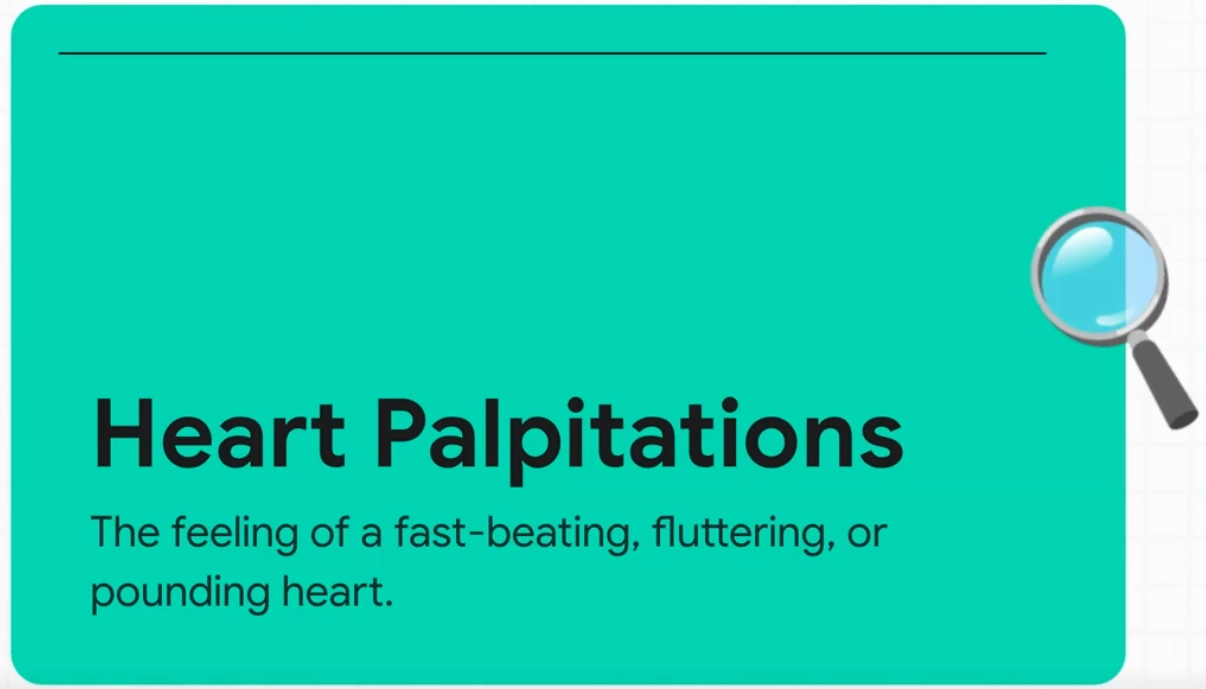
Slide defining heart palpitations as fast-beating, fluttering, or pounding heart sensations.
Text stating that palpitations often signal a sensitive system, not a damaged heart.
1

Accelerator & Brake:
Autonomic Nervous System

The Autonomic Nervous System Working As The Accelerator And Break

Let’s talk about what causes heart palpitatons and begin by taking a look at the Autonomic Nervous System (ANS) (McCorry L.K., 2007 PubMed).

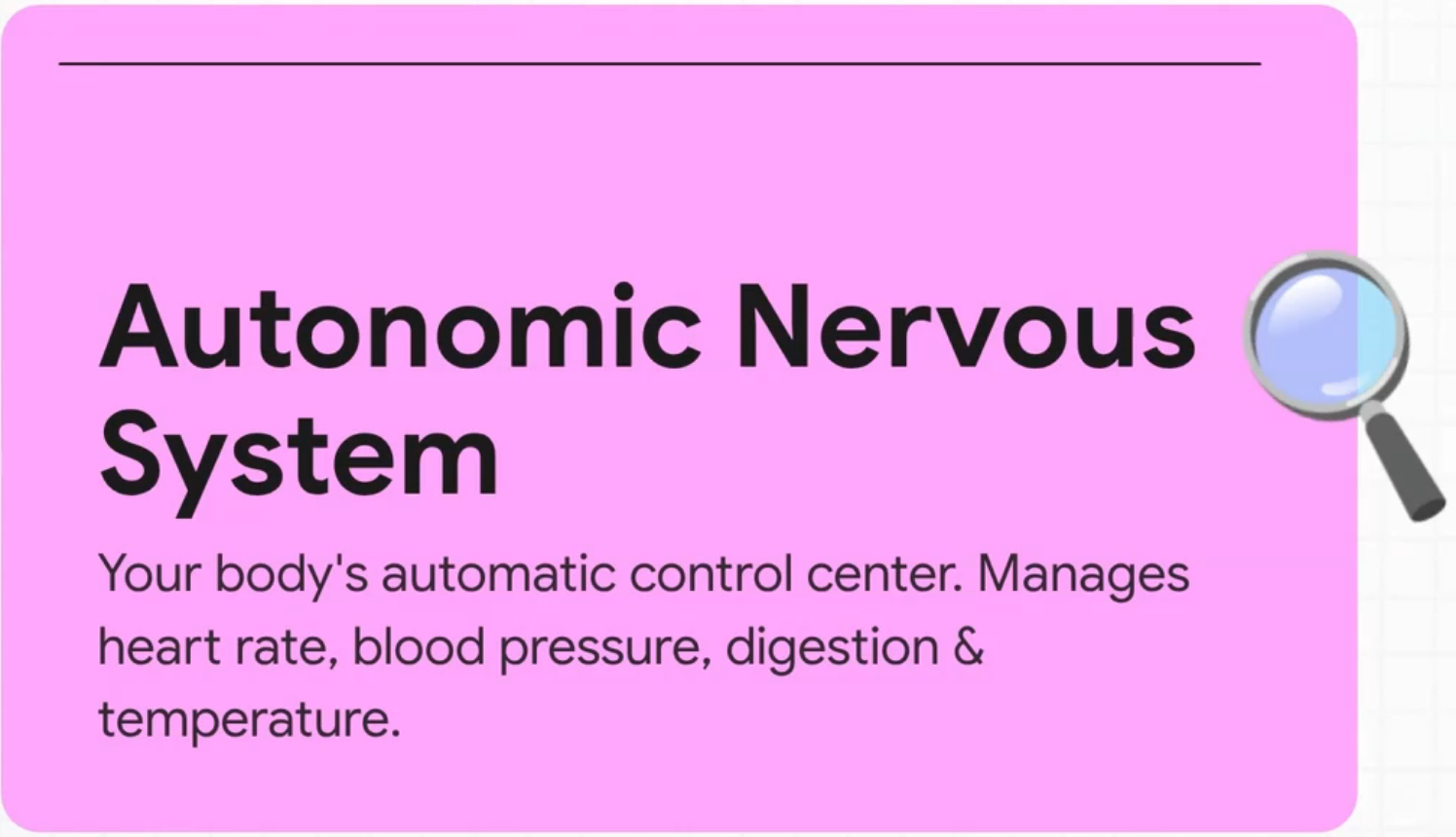
The ANS functions like the body’s internal gas pedal and brake. It’s your body’s automatic control center and is responsible for managing heart rate, blood pressure, digestion and temperature. The ANS can add fuel to these factors and speed them up, it’s also the system that can jump in to slow it down. 

Educational card describing autonomic nervous system managing heart rate, pressure, digestion, and temperature.”

The autonomic nervous system has two components. First, we have the sympathetic system, which acts as the accelerator, or the fuel, driving the “fight or flight” response, while the parasympathetic system, primarily through the vagus nerve, serves as the brake, promoting “rest and digest” activity (J. F. Thayer & R. D. Lane (2000) PubMed).

When these systems are balanced, the body transitions smoothly between activity and rest. On the other hand, when that balance is disrupted, when the accelerator sticks or the brake weakens, the heart rate can suddenly surge.

Illustration comparing sympathetic “accelerator” and parasympathetic “brake” roles in heart rate control.
2

Why The System Overreacts:
Exploring The Triggers

Why Does The Autonomic Nervous System Overreact?

One key question that arises is why this system overreacts. What pushes that internal gas pedal down so hard? What is the trigger? 

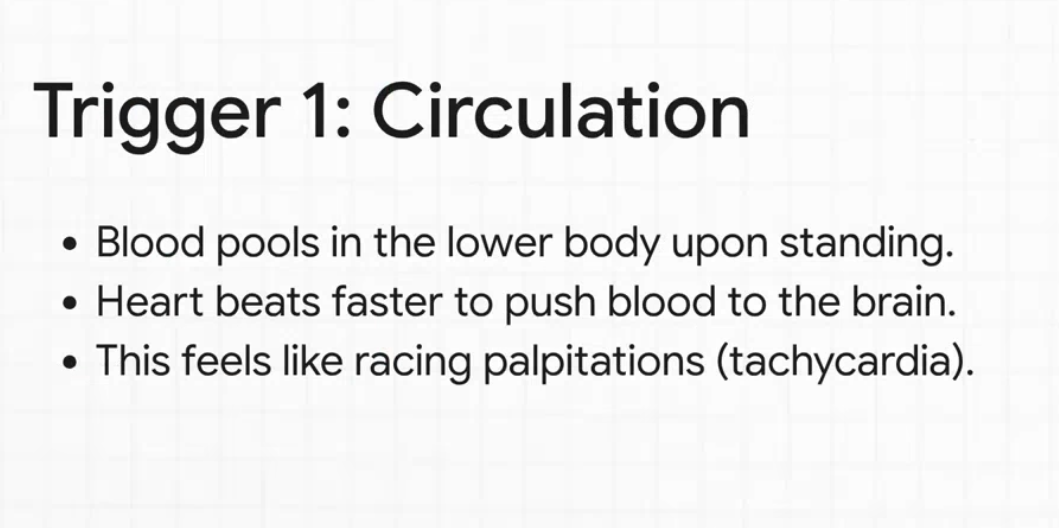
For individuals with POTS or other autonomic imbalances, something as simple as standing up can trigger palpitations. Gravity pulls blood toward the feet, and the body responds by rapidly increasing the heart rate to maintain brain blood flow. This reaction, known as tachycardia, produces the familiar sensation of a racing heartbeat (Geddes J., Mehlsen J., Olufsen M.S., 2019. Arvix.org).

Bullet points explaining circulation-triggered palpitations such as blood pooling in the legs and compensatory tachycardia.

Another major trigger involves adrenaline. The limbic system, the brain’s emotional center, releases this hormone when it perceives stress, whether it’s a real threat or simply a stressful thought. The surge floods the bloodstream with adrenaline, signaling the heart to beat faster and harder (Ulrich-Lai & Herman (2009 PubMed).

Flow diagram showing: stress perceived → adrenaline release → heart reacts.

What happens over time is that these repeated adrenaline surges can condition the body to overreact. The heart becomes primed for alertness, maintaining a constant sense of readiness. It’s pre-empting that surge and that danger. 

Other physiological factors include stress and circulation, which both play major roles, even though there are several additional factors that can make the system more sensitive. Let’s explore some more of these triggers for heart palpitations next. 

Graphic showing a circular “Triggers” chart with four categories: breathing patterns, electrolyte balance, gut health, and cellular energy.

Other Physiological Triggers For Heart Palpitations

Breathing Patterns
When the body is tense, breathing often becomes short and shallow. This lowers carbon dioxide (CO₂) levels in the blood, shifting the body’s chemistry and stimulating sympathetic activity, which increases heart rate (Jerath et al., 2015 PubMed). If we can imagine an orchestra, it’s like the woodwind section of the orchestra losing air pressure, suddenly the whole group can’t stay in sync.

Hydration and Electrolytes
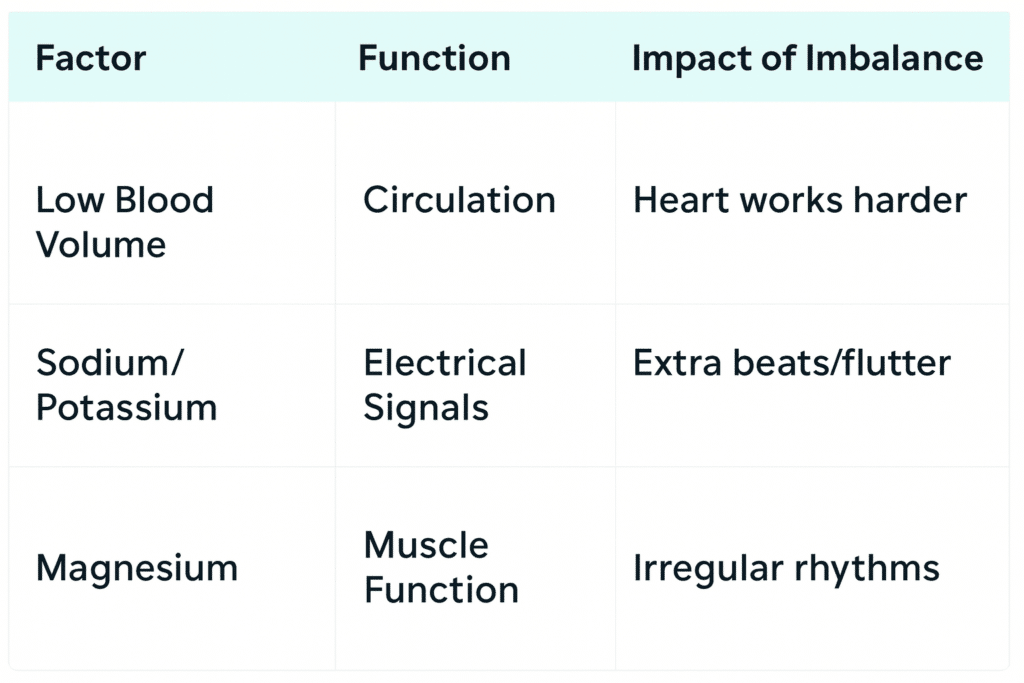
Dehydration lowers blood volume, forcing the heart to work harder. Electrolytes like sodium, potassium, and magnesium are vital for stable electrical activity in the heart. When they’re imbalanced, electrical “misfires” can occur, experienced as flutters or skipped beats (Laslett et al., 2020 PubMed.) This is the orchestra’s soundboard losing power, when the electrical system flickers, the music becomes jumpy or distorted.

Gut–Brain–Heart Connection
The vagus nerve links the gut, brain, and heart. If the gut becomes inflamed or irritated, signals sent through this nerve can disrupt heart rhythm and contribute to autonomic instability (Breit, Sigrid et al. 2018,  PubMed). It’s like a frantic message from backstage distracting the conductor where the whole orchestra stutters because the communication line is noisy.

Cellular Energy Supply
The heart is one of the body’s most energy-demanding organs. When its cells don’t generate sufficient energy, due to nutrient deficits or mitochondrial dysfunction, they become hypersensitive to changes in autonomic tone (Froment, Pascal et al. 2002,  PubMed). This is like the orchestra trying to perform with dim stage lights, when energy is low, even small changes throw the musicians off balance.

Table showing factors such as blood volume, sodium/potassium, and magnesium with their functions and impacts on heart rhythm.
3

The Common Thread:
Imbalance, Not Damage

What Is The Common Thread That Causes Heart Palpitations? 


Across all these triggers, changes in posture, adrenaline surges, breathing patterns, hydration, gut function, and cellular energy, there is one common theme: the body is overcompensating to maintain internal stability. It’s trying to protect you, when all of these signals are firing. 

Text slide stating that circulation, stress, and metabolism share the same root cause behind palpitations.

A palpitation is not the sign of a failing heart, it’s evidence of the body’s extraordinary effort to keep everything in balance, ensuring adequate circulation to the brain and vital organs.

Text slide stating the body is overcompensating to maintain stability, with highlighted words “overcompensating” and “stability.”
4

Finding Your Rhythm:
The Path to Balance

How To Overcome Heart Palpitations? 

When viewed through this lens, the goal is not to “fix” the heart but to support the system that is working hard to maintain balance. This includes calming the brain’s overactive alarm response, replenishing water and minerals to establish proper hydration, and strengthening the parasympathetic “brake” to restore equilibrium.

Slide titled “The Path Forward” listing steps: calming the brain’s alarm system, optimizing hydration and minerals, and strengthening the parasympathetic brake.

As expressed beautifully…
“Heart palpitations are the body’s way of saying, ‘I’m working hard to find balance.’ With the right support, it can learn to steady its rhythm again.”
That fluttery feeling is not a failure, it’s a call for attention. Instead of reacting with fear, consider a different question…What is my body trying to tell me? If you experience heart palpitations, take our quick and comprehensive symptoms evaluation assessment to find out more about your palpitations and any other symptoms. You’ll also receive personal insights and understanding specific to the symptoms you are experiencing. 

Quote slide saying heart palpitations are the body’s way of working hard to find balance.

Do you Have Dysautonomia?

Take our quick and comprehensive symptom assessment to find out if your symptoms align with dysautonomia and receive personalized insights.

Frequently Asked Questions
Are heart palpitations always a sign of heart disease?

No. Most palpitations result from temporary imbalances in the autonomic nervous system, not structural heart damage. They often reflect an exaggerated stress response or circulatory adjustment rather than cardiac pathology (Mayou R, Bryant B, Forfar D, Clark D PubMed).

The sympathetic system accelerates heart rate during stress, while the parasympathetic system slows it for recovery. When these systems lose balance, heart rate fluctuations and palpitations can occur (Thayer & Lane, 2009 PubMed).

Yes. In individuals with postural orthostatic tachycardia syndrome (POTS), standing can momentarily decrease blood flow to the brain. The heart compensates by increasing its rate, leading to palpitations (Raj, 2013 PubMed).

Stress activates the limbic system, releasing adrenaline that speeds the heart and heightens awareness of its rhythm. Frequent stress can condition the body into a chronic overreactive state (Goldstein, 2010 PubMed).

Rapid, shallow breathing lowers blood CO₂, which can activate the sympathetic nervous system and increase heart rate. Slow, diaphragmatic breathing restores balance and supports parasympathetic recovery (Jerath et al., 2015 PubMed).

Yes. Low fluid volume or deficiencies in sodium, potassium, or magnesium alter cardiac electrical activity and may trigger irregular beats (Dyckner & Wester, 1982 PubMed).

The vagus nerve links gut activity to heart regulation. Inflammation or imbalance in the digestive system can send stress signals to the brain and heart, influencing rhythm stability (Bonaz et al., 2018 PubMed).

References

  • Lampert, R., Jain, D., Burg, M. M., & Dziura, J. (2014). Autonomic influences on cardiac arrhythmia: mechanisms and management. Progress in Cardiovascular Diseases, 56(2), 146–156. PubMed
  • Thayer, J. F., & Lane, R. D. (2009). Claude Bernard and the heart–brain connection: further elaboration of a model of neurovisceral integration. Neuroscience & Biobehavioral Reviews, 33(2), 81–88. PubMed
  • Raj, S. R. (2013). Postural tachycardia syndrome (POTS). Circulation, 127(23), 2336–2342. PubMed
  • Goldstein, D. S. (2010). Adrenal responses to stress. Cellular and Molecular Neurobiology, 30(8), 1433–1440. PubMed
  • Jerath, R., Edry, J. W., Barnes, V. A., & Jerath, V. (2015). Physiology of long pranayamic breathing: neural respiratory elements may provide a mechanism that explains how slow deep breathing shifts the autonomic nervous system. Medical Hypotheses, 85(3), 486–496. PubMed
  • Dyckner, T., & Wester, P. O. (1982). Potassium–magnesium interactions in arrhythmias. Acta Medica Scandinavica, 211(5), 485–488. PubMed
  • Bonaz, B., Bazin, T., & Pellissier, S. (2018). The vagus nerve at the interface of the microbiota–gut–brain axis. Frontiers in Neuroscience, 12, 49. PubMed
  • Brown, D. A., Perry, J. B., Allen, M. E., Sabbah, H. N., Stauffer, B. L., Shaikh, S. R., Cleland, J. G., Colucci, W. S., Butler, J., Voors, A. A., & Sabbah, H. (2017). Expert consensus document: mitochondrial function as a therapeutic target in heart failure. Nature Reviews Cardiology, 14(4), 238–250. PubMed

Read More Articles

joint pain explained

Joint Pain Explained: When Inflammation Becomes a Systemic Signal

Home Symptoms Explainer Joint Pain The Systemic Roots of Joint Pain Joint pain is not merely a mechanical issue of cartilage wearing down, it is often a systemic signal of deeper biological stress. Emerging research on systemic inflammation and joint pain reveals the interconnected roles of the gut, mitochondria, and
Read More »
Temperature Sensitivity

Temperature Sensitivity

Many people struggle with feeling too hot or too cold when others feel fine. This article explores how the autonomic nervous system, cellular energy, and inflammation control internal temperature and why these systems can fall out of balance.

Read More »

Why Your Hands Get Freezing Cold

Cold hands and feet often reflect more than poor circulation, they’re signals from the nervous system. This article explains how vasoconstriction, stress, and autonomic imbalance redirect blood flow and what that reveals about the body’s intelligent protective mechanisms.
Read More »

The Biology of Hopelessness

Hopelessness is not a personal failure but a biological state driven by chronic stress and nervous system overload. When survival mode dominates, the amygdala, stress hormones, and energy systems shift, suppressing motivation and perspective. Understanding this physiology creates a clear path toward restoration.

Read More »

Share This Article

Comments
Subscribe
Notify of
guest
0 Comments
Oldest
Newest Most Voted
Inline Feedbacks
View all comments