Constipation Explained: Causes, Symptoms & Nervous System Roots

Constipation is often approached as a simple mechanical problem, yet chronic constipation frequently reflects a deeper disruption in communication between the brain, autonomic nervous system, gut, and pelvic floor. When the nervous system remains in a state of stress, vagal signaling weakens, blood flow shifts away from digestion, the microbiome changes, and normal motility slows.

These patterns show that constipation is not merely a gut issue but a systems-level imbalance driven by autonomic dysregulation, altered energy delivery, hormonal shifts, and muscular tension. Understanding this nervous system–based framework helps explain why standard gut-only approaches often fall short and why restoring regulation across the entire system is essential for meaningful recovery.

Written by Scott Pringle, Founder of the Integrated Health Foundation
Table of Contents

What Is Constipation?

Constipation typically refers to infrequent bowel movements (often fewer than three per week), hard or lumpy stools, straining, or a persistent feeling that you didn’t fully empty. It can be occasional and situational. Or it can become chronic, recurring, and disruptive to daily life.

It isn’t just “not going.” It usually means bowel movements are infrequent, difficult to pass, or incomplete. Often with hard, dry stools. For some people it’s mainly diet, hydration, or routine. For others, chronic constipation can reflect deeper patterns in motility, inflammation, hormones, and nervous system regulation.

Constipation may not be the most glamorous topic, but it is an important one, because what if it has been viewed the wrong way? What if constipation is not just a simple plumbing issue but a complex signal the body is trying to express? And what if the real root of the problem is not even in the gut at all?

Anyone who has struggled with chronic constipation has heard all the common advice: add more fiber, drink more water. And for some, that may be enough. But for many, these strategies lead to a frustrating dead end. It can feel as though everything has been attempted, yet nothing truly resolves the issue for good.

Illustration showing a brain with text stating that the root cause of constipation may not be located in the gut.

That may be because the real issue is not what is going into the gut but what is happening in the system that controls the gut: the nervous system.

Illustration showing a brain with text stating that the root cause of constipation may not be located in the gut.
1

The Nervous System Switch:
Your Body's Two Modes

The Autonomic Nervous System: The Gut’s Operating System

To understand this, the autonomic nervous system must be considered. The body essentially has two main operating modes directing how energy and resources are used from moment to moment, similar to a gas pedal and a brake.

Autonomic Nervous System States and Digestion

Sympathetic Mode (Gas Pedal)

The gas pedal is the fight-or-flight response, the sympathetic state. During stress, anxiety, or periods of constant busyness, the body hits the gas. Resources shift to the muscles and brain to navigate perceived threat, and digestion is deprioritized. Sympathetic activation is known to inhibit gut motility and slow transit.

Graphic explaining the parasympathetic nervous system as the rest-and-digest branch that activates digestion via the vagus nerve.

Parasympathetic Mode (Brake)

The brake pedal is the rest-and-digest state, the parasympathetic system. When the body feels safe, it initiates digestion, increases gut blood flow, and activates the rhythmic contractions needed for movement. This parasympathetic influence is largely mediated through the vagus nerve (Breit et al., 2018 PubMed).

If this vagal “go” signal fails to activate, the gut never receives the message to begin working.

2

Six Hidden Connections:
Nervous System & Gut

The 6 Ways That Constipation Is Linked To The Nervous System

Because the nervous system functions as the gut’s control panel, dysfunction can create a significant traffic jam. There are six key ways autonomic state directly influences constipation.

1. Chronic Stress Weakens Peristalsis

First, chronic fight-or-flight activation, due to prolonged stress, trauma, or disrupted sleep, continually deprioritizes digestion. Peristalsis, the muscular wave pattern that moves material forward, weakens under sympathetic dominance (Furness, 2012 PubMed). Digestion begins to resemble trying to surf on a flat ocean: no momentum.

Text graphic explaining that fight-or-flight weakens peristalsis, the rhythmic waves that move stool through the gut.

2. The Brain – Gut Feedback Loop

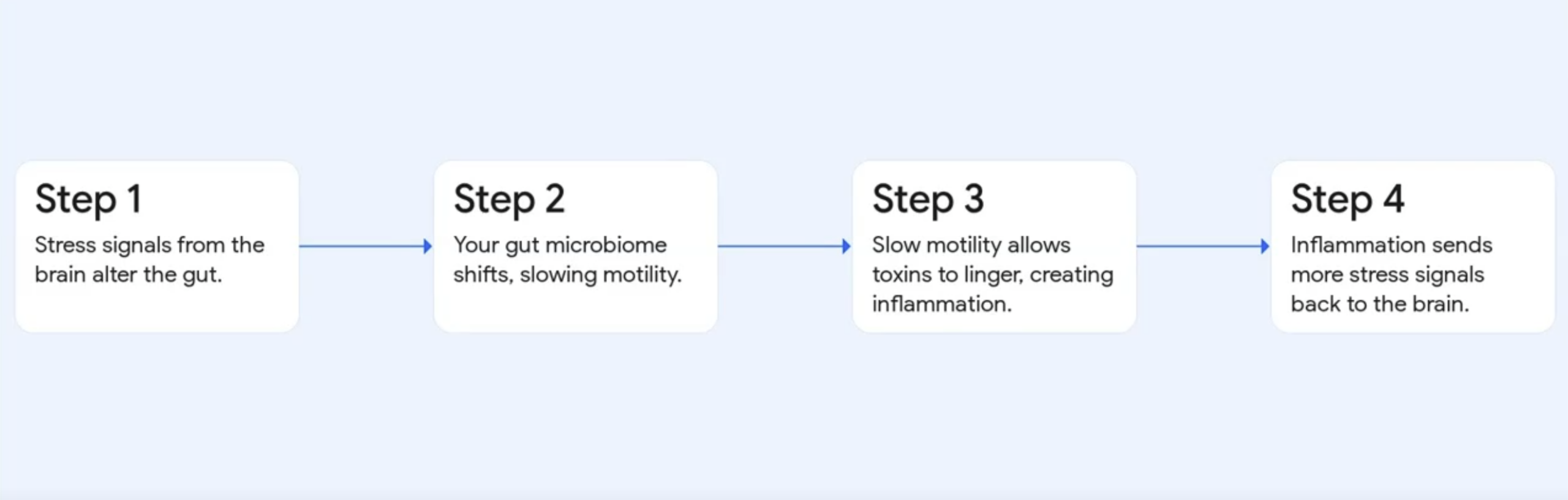
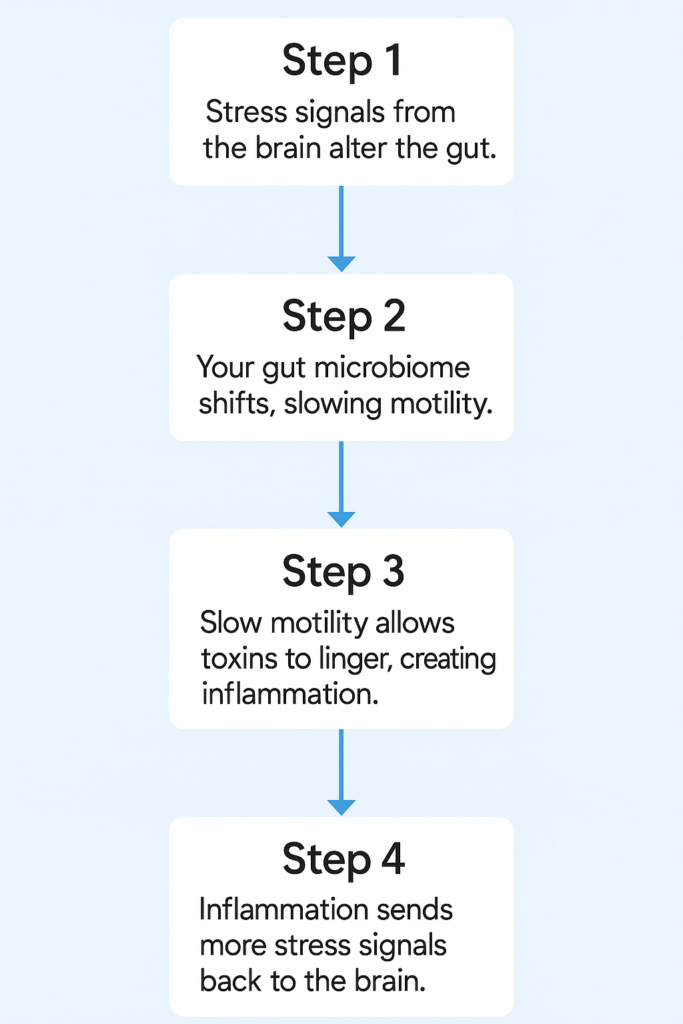
Secondly, a brain–gut feedback loop can emerge. Stress signals from the brain can alter the gut environment and reshape the microbiome, producing measurable changes in gastrointestinal physiology through the gut–brain–microbiota axis (Ying et al., 2025 PubMed). When movement slows, toxins linger longer, generating inflammation. When this happens, it is sending amplified stress signals back to the brain and reinforcing the cycle.

Flow diagram showing stress signals altering the gut, slowing motility, increasing inflammation, and sending stress signals back to the brain.

3. Low Energy and Blood Flow to the Gut

Third, the gut requires adequate fuel. As a muscular organ, the intestines need oxygen and ATP to contract. Autonomic dysfunction is associated with altered regulation of intestinal blood flow and gastrointestinal responses, demonstrating how nervous system imbalance can affect digestive function (Bennett et al., 2024 PubMed). When fuel is insufficient, the gut attempts to operate on empty, producing heaviness, sluggishness, or fatigue after eating.

Graphic stating that gut muscles require oxygen and ATP energy to function properly.

4. Hormones and Electrolytes

Fourth, the body’s chemistry also shapes motility. Autonomic patterns influence hormones and electrolyte status. Underactive thyroid function, adrenal strain, and low levels of key minerals, including magnesium, sodium, and potassium, can impair smooth muscle function and alter stool patterns. The role of these electrolytes in muscle activity is well established (Dyckner & Wester, 1981 PubMed).

Text graphic noting that thyroid, adrenal hormones, magnesium, sodium, and potassium imbalances impair bowel function.

5. Limbic (Emotional Brain) Patterns

Fifth, limbic system patterns contribute. The emotional centers of the brain may learn to remain in high-alert states due to chronic stress. This persistent defensive orientation sends danger signals that suppress digestion even when the environment is safe. Limbic activation is closely tied to autonomic output through neurovisceral integration (Thayer & Lane, 2009 PubMed).

Over time, the body can lose familiarity with the neurological pathway leading back to rest-and-digest.

Bullet list describing limbic system threat signaling suppressing digestion and rest-and-digest access.

6. Pelvic Floor and Muscular Tension

Sixth, there can be a literal structural barrier. Chronic tension in the pelvic floor, lower back, or abdominal muscles can physically restrict stool passage even when internal signaling is intact. Pelvic floor dysfunction is a recognized contributor to constipation (Müller-Lissner et al., 2017 PubMed).

3

The Common Thread:
Putting It All Together

The Unifying Insight

These six mechanisms, ranging from brain signaling to blood flow to mechanical tension, share a unifying principle:

Chronic constipation is often a systems-level communication breakdown, not a gut failure.

The brain may not convey safety to the gut. Circulatory flow may not deliver adequate fuel. The issue becomes a full-body challenge, explaining why gut-only solutions frequently fail.

Text stating constipation is a systems-level communication breakdown, not just a fiber or water problem.
4

A Path Back to Rhythm:
Supporting Your System

The Path to Recovery For Constipation and How To Support Your Nervous System

If the root lies in the nervous system, that is where solutions should begin. The goal is not merely to force movement in the gut but to support the entire system in reestablishing rhythmic function.

This shifts the approach from increasing fiber to calming the overactive emotional brain, through methods such as slow breathing, which enhances parasympathetic activity (Jerath et al., 2006 PubMed). It involves gently restoring rest-and-digest signaling through movement, hydrating with balanced electrolytes, and supporting a microbiome capable of sending healthy feedback to the brain.

Bullet list of supportive approaches including calming the limbic system, restoring parasympathetic tone, hydration with electrolytes, and microbiome support.

Constipation, then, is not a gut failure but a message, a signal that the system is stuck in survival mode and needs support returning to a state of safety, rest, and rhythm.

So the next time that sluggishness or backup appears, instead of immediately reaching for a quick fix, there may be value in pausing and asking a different question:

When stress levels, energy availability, and the overall sense of safety are considered, what is the body actually trying to communicate?

This shift in perspective reframes constipation not as a failure, but as a message. It becomes a signal from a system needing support to return to rhythm and regulation.

If constipation is part of a broader pattern, maybe alongside fatigue, dizziness, temperature swings, anxiety, insomnia, or food sensitivity, then your body may be asking for nervous system support, not just digestive hacks.

Click below to take our free Symptoms Evaluation Assessment, to find our more about what could be coming up for you. 


Do You Have Dysautonomia?

Take our quick and comprehensive symptom assessment to find out if your symptoms align with dysautonomia and receive personalized insights.

Frequently Asked Questions
How does the nervous system influence constipation?

Autonomic balance determines gut motility. Sympathetic activation suppresses peristalsis, whereas parasympathetic activation enhances it.

Yes. Stress alters vagal tone, reshapes the microbiome, slows motility, and reinforces a brain – gut feedback loop.

The intestines require oxygen and ATP for effective contractions. Autonomic dysfunction can limit blood flow and slow transit.

Magnesium, sodium, and potassium regulate smooth muscle activity. Deficiencies can impair contraction and motility.

Yes. Tight or uncoordinated pelvic floor muscles can create mechanical obstruction even when gut signaling is normal.

Stress can shift microbial populations toward species that slow motility and increase inflammation.

Slow diaphragmatic breathing improves parasympathetic tone and can support digestive activation.

References

Read More Articles

joint pain explained

Joint Pain Explained: When Inflammation Becomes a Systemic Signal

Home Symptoms Explainer Joint Pain The Systemic Roots of Joint Pain Joint pain is not merely a mechanical issue of cartilage wearing down, it is often a systemic signal of deeper biological stress. Emerging research on systemic inflammation and joint pain reveals the interconnected roles of the gut, mitochondria, and
Read More »

Explaining Palpitations

Heart palpitations can feel sudden and alarming, yet they usually arise from the body’s regulation systems, not from heart disease. This article explores how stress, posture, breathing, hydration, minerals, and gut health affect rhythm and reveal the body working to stay balanced.
Read More »
Temperature Sensitivity

Temperature Sensitivity

Many people struggle with feeling too hot or too cold when others feel fine. This article explores how the autonomic nervous system, cellular energy, and inflammation control internal temperature and why these systems can fall out of balance.

Read More »

Why Your Hands Get Freezing Cold

Cold hands and feet often reflect more than poor circulation, they’re signals from the nervous system. This article explains how vasoconstriction, stress, and autonomic imbalance redirect blood flow and what that reveals about the body’s intelligent protective mechanisms.

Read More »

Share This Article

Subscribe
Notify of
guest
0 Comments
Oldest
Newest Most Voted
Inline Feedbacks
View all comments